How Often Should Commercial Offices Be Professionally Cleaned?
Most commercial offices in Fort Worth should be professionally cleaned at least 2 to 5 times per week, with busy offices often benefiting from daily service. The right frequency depends on employee count, visitor traffic, restrooms, shared spaces, flooring, and the type of business. High-touch surfaces and heavily used areas generally require more frequent attention than low-traffic spaces.
At Alpine Building Maintenance & Supply, we understand that no two Fort Worth offices operate exactly the same way. A small professional office with limited visitors has very different cleaning requirements than a busy corporate building with shared conference rooms, break areas, and customer-facing spaces. Serving the DFW area since 1978, Alpine develops customized cleaning programs around each facility’s actual needs rather than relying on a one-size-fits-all schedule. Our focus on communication, quality control, and responsive customer care helps businesses maintain clean, professional workplaces without spending valuable time managing day-to-day janitorial details.
Finding the Right Commercial Office Cleaning Schedule in Fort Worth
A good commercial cleaning schedule is based on how the office is used, not simply its square footage. Cleaning frequency should increase as occupancy, visitor traffic, shared spaces, and sanitation needs increase.
The Centers for Disease Control and Prevention (CDC) recommends regularly cleaning high-touch surfaces in facilities and cleaning other surfaces when they become visibly dirty. The CDC also notes that high-traffic areas may need to be cleaned more frequently. These recommendations make a customized cleaning schedule especially valuable for commercial offices.
Should a Commercial Office Be Cleaned Every Day?
Daily professional cleaning is often appropriate for high-traffic offices, but not every workplace requires full cleaning seven days a week.
An office that operates Monday through Friday, for example, may benefit from professional cleaning every business day. Daily service is particularly useful when a workplace has:
- Large numbers of employees
- Frequent customers or visitors
- Multiple restrooms
- Shared kitchens or break rooms
- Conference and training rooms
- High-traffic lobbies and entrances
- Large amounts of daily trash
- Frequently touched shared surfaces
Daily service does not necessarily mean that every cleaning task needs to be completed every day. Restrooms, trash, floors in high-traffic areas, and frequently touched surfaces may need daily attention, while baseboards, blinds, vents, and other low-touch areas can typically be placed on a weekly, monthly, or periodic rotation.
This risk-based approach is consistent with CDC guidance, which recommends considering both the type of surface and how frequently people touch it when determining cleaning frequency.
Can a Smaller Office Be Professionally Cleaned Two or Three Times Per Week?
Yes. A smaller, lower-traffic office may be able to maintain a clean professional environment with service two or three times per week.
For example, an office with a relatively small staff, few outside visitors, limited food preparation, and light restroom use may not require nightly janitorial service. A customized schedule could focus professional cleaning on Monday, Wednesday, and Friday while employees handle minor daily tasks such as keeping personal workspaces organized.
The condition of the facility should determine whether that schedule is sufficient. Warning signs that an office needs more frequent cleaning include:
- Trash accumulating between visits
- Restrooms looking or smelling unclean
- Visible debris on floors
- Fingerprints on glass and doors
- Dust building up on surfaces
- Break rooms becoming messy between cleanings
- Employees or customers regularly noticing cleanliness issues
If these problems appear before the next scheduled service, increasing cleaning frequency may be more effective than continually trying to catch up.
What Areas of a Fort Worth Office Need the Most Frequent Cleaning?
Restrooms, entrances, break rooms, shared spaces, and high-touch surfaces usually require the most frequent attention.
According to the CDC, examples of high-touch surfaces include door handles, stair rails, elevator buttons, touchpads, restroom fixtures, desks, and similar frequently contacted surfaces. The agency recommends cleaning high-touch surfaces regularly and considering additional cleaning in high-traffic areas.
For a typical Fort Worth office, the cleaning schedule might look like this:
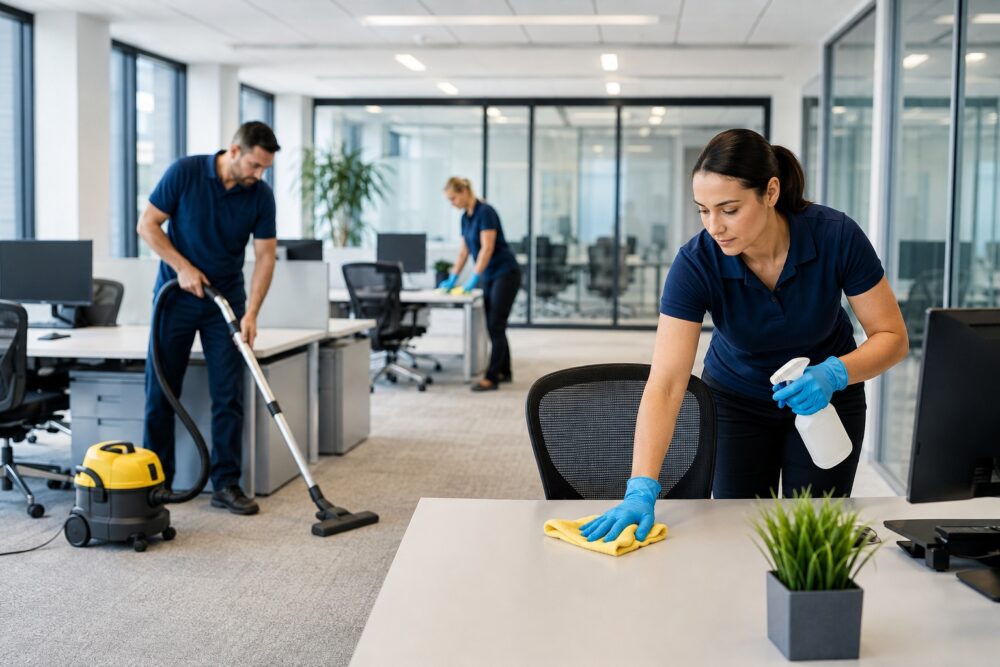
Daily or each service visit: Trash removal, restroom cleaning, break room cleaning, high-touch surface cleaning, entryway care, spot cleaning, and vacuuming or mopping heavily traveled floors.
Weekly: More detailed dusting, lower-traffic floor care, interior glass cleaning, furniture cleaning, and attention to areas that do not require daily service.
Monthly or periodically: Detailed floor care, high dusting, baseboards, vents, blinds, upholstery, carpet cleaning, and other deeper cleaning tasks based on facility conditions.
Fort Worth offices can also experience tracked-in dust, pollen, moisture, and debris throughout the year. Offices near busy commercial areas such as Downtown Fort Worth, Near Southside, and the Alliance corridor may also experience significant employee and visitor traffic. Entryways, mats, hard floors, and carpeting should therefore be monitored and incorporated into the facility’s cleaning plan rather than cleaned according to an arbitrary calendar.
What Factors Determine How Often an Office Should Be Cleaned?
Occupancy and traffic are usually the biggest factors, but the ideal schedule also depends on the building, business, and expectations of the people using it.
Consider these factors when determining cleaning frequency:
- Number of employees: More people generally create more trash, restroom use, floor traffic, and contact with shared surfaces.
- Customer traffic: Reception areas, conference rooms, and public restrooms may require more frequent cleaning when customers regularly visit the facility.
- Flooring: Carpet, tile, concrete, and other surfaces have different maintenance requirements. High-traffic flooring often needs both routine cleaning and scheduled deeper maintenance.
- Restroom usage: A restroom serving dozens or hundreds of people each day requires more frequent attention than one used by a small staff.
- Food and break areas: Shared kitchens, coffee stations, and break rooms can quickly accumulate crumbs, spills, trash, and residue.
- Business type: Medical offices and certain specialized facilities can have cleaning requirements beyond those of a standard administrative office.
- Operating schedule: Offices with evening shifts, weekend operations, or extended hours may need more frequent or differently timed service.
OSHA also requires employers to ensure workplaces, passageways, storerooms, service rooms, and walking-working surfaces are kept in a clean, orderly, and sanitary condition. A consistent professional cleaning program can help businesses maintain those conditions while reducing the burden on employees and facility managers.
How Do You Know If Your Current Cleaning Schedule Is Enough?
Your cleaning schedule is working when the office remains consistently clean between service visits, not just immediately after the cleaning crew leaves.
Facility managers should regularly inspect restrooms, entrances, floors, break rooms, conference spaces, and other frequently used areas. If those spaces repeatedly deteriorate before the next cleaning, the schedule may need adjustment.
At Alpine Building Maintenance & Supply, customization is a central part of our approach. Instead of forcing every business into the same cleaning checklist, we evaluate the facility’s priorities and develop a program around its needs. Alpine also uses monthly quality control inspections and provides responsive management support to help maintain consistent service.
The goal is not simply to schedule as many cleaning visits as possible. It is to establish the right frequency for the facility, then adjust the scope as occupancy, seasons, business hours, or other conditions change.
Frequently Asked Questions About Office Cleaning Frequency
How many times per week should an office be professionally cleaned?
Most commercial offices can start with professional cleaning 2 to 5 times per week. High-traffic workplaces commonly benefit from daily weekday cleaning, while smaller offices may maintain acceptable conditions with two or three visits per week.
Should office restrooms be cleaned every day?
Busy commercial office restrooms should generally receive daily attention, and very high-use restrooms may need servicing more than once during the day. Cleaning frequency should be based on usage and facility conditions rather than a fixed universal schedule.
How often should office carpets be professionally cleaned?
Routine vacuuming should be performed much more frequently than deep carpet cleaning. The appropriate professional carpet cleaning schedule depends on foot traffic, soil levels, carpet type, entry matting, and manufacturer recommendations, with heavily traveled areas typically requiring more frequent care.
Is professional office cleaning required every night?
No. Nightly cleaning can be appropriate for busy workplaces, but smaller, lower-traffic offices may only require professional service several times per week. The best schedule is one that keeps the facility consistently clean, sanitary, and presentable between visits.
Create the Right Office Cleaning Schedule for Your Fort Worth Business
Professional office cleaning should be frequent enough that employees, customers, and visitors consistently encounter a clean and welcoming environment. For many Fort Worth businesses, that means service between two and five times per week, with daily cleaning often being the better choice for busy facilities.
Alpine Building Maintenance & Supply has served businesses throughout Tarrant County and surrounding communities since 1978. Our customized commercial cleaning programs are designed around your facility, schedule, traffic, and priorities, giving you the level of service you actually need instead of a generic cleaning package.
Ready to create a professional office cleaning schedule that fits your Fort Worth business? Contact Alpine Building Maintenance & Supply today to discuss a customized cleaning plan.